What's breaking right now
What is breaking on most photography sites
Cost of delay
A slow response can cost the booking, the add-on sale, or the repeat relationship that should have followed.
The handoff is not leaking because the homepage is ugly. It is leaking because the website and HoneyBook are not sharing the same first minute. That is broken-handoff repair for businesses on HoneyBook.
Path fit
What a HoneyBook-connected website does instead
The site captures the event date, session type, location, and budget first, then either embeds HoneyBook's contact form or routes to a direct link that creates the inquiry project. When the studio needs more analytics or routing control, an external form can qualify the inquiry before an automation layer creates the HoneyBook project.
Native path
Use HoneyBook's contact form widget or direct link when the studio wants the simplest path into the inquiry pipeline.
Controlled path
Use an external form plus an automation layer when the website needs more qualification, analytics, or routing than HoneyBook's native form flow can provide.
When someone asks AI who to hire for photography, your site should survive the comparison.
Buyers are not just using Google. They are using AI to compare options, verify claims, and build a shortlist before they click through. That means answering the obvious questions clearly, showing proof that fits this buyer, and making the next step easy once they arrive.
What that requires
- Answer the obvious questionsReplace vague brochure copy with direct answers about fit, timing, pricing, and what happens next.
- Back the claims with proofPut the proof where the buyer feels the most doubt: examples, specifics, response expectations, and real outcomes.
- Make the next step easyGive the buyer a clear action and route the inquiry into the right person and the right software.
Before / after
How the HoneyBook handoff changes once the page is fixed
Before
- 1Website form submission lands in a generic inbox.
- 2Someone checks it later and has to reconstruct the request.
- 3The first callback starts without the detail needed to open the right project request.
- 4Response slows down while the buyer is still comparing alternatives.
- 5HoneyBook either sees an incomplete handoff or never sees it at all.
After
- 1Website form submission is categorized immediately.
- 2project request in HoneyBook is created under 60 seconds.
- 3The right person gets a owner alert with the full context attached.
- 4The site triggers the project follow-up while intent is still hot.
- 5Nothing falls through because HoneyBook saw the inquiry first.
Leakage estimate
About 4 inquiries a month are at risk here.
That is roughly $12,800 in revenue pressure if the handoff keeps slowing down before HoneyBooksees the inquiry.
Directional estimate based on 21 monthly inquiries and about 18% of them not making it through, with $3,200 per inquiry.
Page proof
HoneyBook + Photography should behave like a real intake handoff, not a contact form
Working proof
Operating proofPhotography intake written for HoneyBook
Target handoff
project request in HoneyBook under 60 seconds
Operational fit
Photography intake logic written for HoneyBook, not generic lead forms
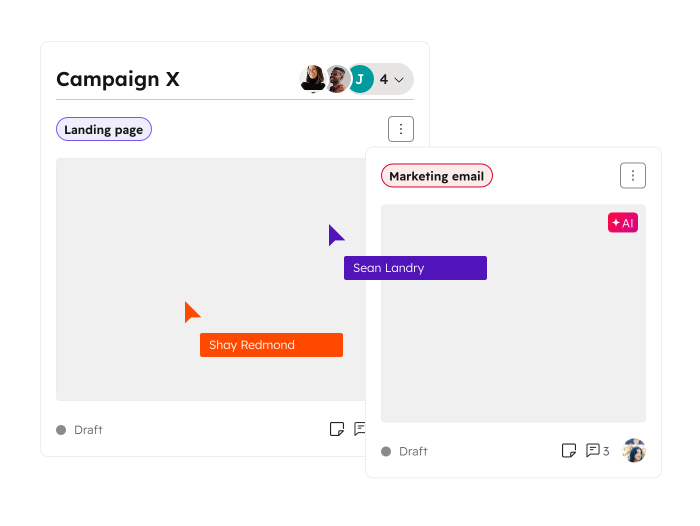
Local feature art for HoneyBook and Photography
- Inquiry-stage project
- Date-based qualification
- HoneyBook form or direct link
Commercial bridge
The System Check comes first. Preview comes after it.
After The System Check
Use Preview once the handoff problem is named.
Start with The System Check so the leak and workflow drag are named before Preview.
Still evaluating
Use The System Check when the problem still needs a name.
If you are not yet sure whether the loss is speed, where the lead goes, or follow-up discipline, use The System Check before you pay for the preview.
Want The System Check first
Start with the public estimate, then come back here.
The System Check gives you a first-pass leakage read. Preview becomes the right move once you want the private fix built around your site.
Related paths