
Your website and your software should work together.

See what's breaking
Swept + Landscaping

Dream outcome

35 landscaping requests last month. Every serious one reached Swept with the right job context already attached. The office stopped rebuilding scope from a thin form fill.

Landscaping websites for Swept with a disciplined handoff

We are frustrated that swept does not document public website embeds, API access, or webhooks for request capture. Capture landscaping requests on-site, route to CRM/email for estimating and scheduling, then manually onboard accepted work into Swept, which turns the website into a handoff delay.
No public API
No native embeds
Manual ops handoff
Swept handoff
Landscaping intake

What's breaking right now

Landscaping intake needs scope and cadence details

We are frustrated that generic forms force teams to re-qualify project scope and schedule in follow-up calls.

Cost of delay

Estimate and booking cycles become slower and less predictable.

The handoff is not leaking because the homepage is ugly. It is leaking because the website and Swept are not sharing the same first minute. That is broken-handoff repair for businesses on Swept.

Path fit

What a Swept-centered landscaping website does instead

Capture scope, property, and timing on-site, route to CRM/email for pre-sale workflow, then manually move accepted jobs into Swept for operations.

Native path

No documented native Swept request-capture embeds.

Controlled path

No documented public Swept API for website request ingestion.

When someone asks AI who to hire for landscaping, your site should survive the comparison.

Buyers are not just using Google. They are using AI to compare options, verify claims, and build a shortlist before they click through. That means answering the obvious questions clearly, showing proof that fits this buyer, and making the next step easy once they arrive.

What that requires

  • Answer the obvious questionsReplace vague brochure copy with direct answers about fit, timing, pricing, and what happens next.
  • Back the claims with proofPut the proof where the buyer feels the most doubt: examples, specifics, response expectations, and real outcomes.
  • Make the next step easyGive the buyer a clear action and route the inquiry into the right person and the right software.

Before / after

How the Swept handoff changes once the page is fixed

The point is not a prettier front end. The point is moving the inquiry from form fill to request in your business software under 60 seconds.

Before

  1. 1Website form submission lands in a generic inbox.
  2. 2Someone checks it later and has to reconstruct the request.
  3. 3The first callback starts without the detail needed to open the right request.
  4. 4Response slows down while the buyer is still comparing alternatives.
  5. 5Swept either sees an incomplete handoff or never sees it at all.

After

  1. 1Website form submission is categorized immediately.
  2. 2request in your business software is created under 60 seconds.
  3. 3The right person gets a team notification with the full context attached.
  4. 4The site triggers the automatic response while intent is still hot.
  5. 5Nothing falls through because Swept saw the inquiry first.

Leakage estimate

About 7 inquiries a month are at risk here.

That is roughly $9,800 in revenue pressure if the handoff keeps slowing down before Sweptsees the inquiry.

Directional estimate based on 35 monthly inquiries and about 20% of them not making it through, with $1,400 per inquiry.

Page proof

Swept + Landscaping should behave like a real intake handoff, not a contact form

This page stays specific to the handoff: what gets captured, what reaches your business software, and how quickly the team can act.

Working proof

Operating proof

Landscaping intake written for Swept

The winning state is simple: the inquiry reaches Swept under 60 seconds, the team sees the right details immediately, and follow-up starts without extra manual work.

Target handoff

request in your business software under 60 seconds

Operational fit

Landscaping intake logic written for Swept, not generic lead forms
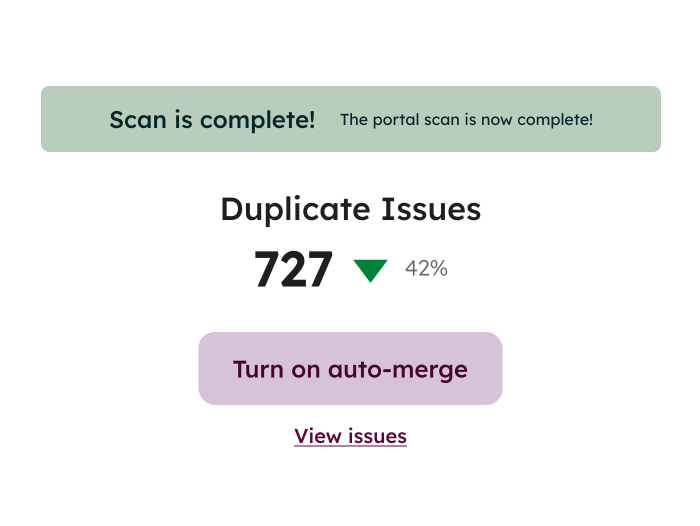
Data Hub Data Quality Command Center

Local feature art for Swept and Landscaping

  • No public API
  • No native embeds
  • Manual ops handoff
  • Swept handoff
  • Landscaping intake

Commercial bridge

The System Check comes first. Preview comes after it.

Keep the path literal: use The System Check to put a number on the leak, then move into Preview to see the fix.

After The System Check

Use Preview once the handoff problem is named.

Start with The System Check so the leak and workflow drag are named before Preview.

Still evaluating

Use The System Check when the problem still needs a name.

If you are not yet sure whether the loss is speed, where the lead goes, or follow-up discipline, use The System Check before you pay for the preview.

Want The System Check first

Start with the public estimate, then come back here.

The System Check gives you a first-pass leakage read. Preview becomes the right move once you want the private fix built around your site.

Related paths

Keep the research path moving.

Adjacent pages should be obvious next clicks, even if there are only one or two of them.
Browse all Swept pages →
Same platform, different vertical

Commercial Cleaning websites for Swept that stop handoff leaks

Our site gives us random 'need cleaning' messages with no square footage, no frequency, and no clue if it is a real contract, a one-time cleanup, or a total mismatch, so by the time we sort it out the walkthrough is gone. When the recurring janitorial contract inquiry hits a slow website handoff, revenue leaks fast. This setup qualifies the request before it reaches Swept so the first response starts with usable context instead of guesswork.
Open page
Same platform, different vertical

Appliance repair websites for Swept that don’t pretend Swept is a request system

We are frustrated that swept is designed for post-sale operations (workforce management) and does not document a public API or native website embeds for marketing request capture. This flow captures appliance repair requests on the website, routes them to email/CRM for sales dispatch, and only hands won work into Swept via manual entry, which turns the website into a handoff delay.
Open page
Same vertical, different platform

Landscaping websites for Jobber that stop callback leaks

Jobber teams usually see the leak when dispatch has to rebuild the story from scratch. We get form fills, but half of them are junk and the good ones sit too long before anyone can call them back. Most landscaping sites leak estimate intent into voicemail and inbox lag. This build qualifies route-fit work, then hands the homeowner into a real Client Request before the design-build or maintenance inquiry cools off.
Open page
Same vertical, different platform

Landscaping websites for LMN (Landscape Management Network) that stop handoff leaks

We get form fills, but half of them are junk and the good ones sit too long before anyone can call them back. When the recurring maintenance request hits a slow website handoff, revenue leaks fast. This setup qualifies the request before it reaches LMN (Landscape Management Network) so the first response starts with usable context instead of guesswork.
Open page